
Beware the Widget People
Every generation produces thinkers who believe the latest technology will dissolve layers of stubborn complexity. They are uniquely dangerous.


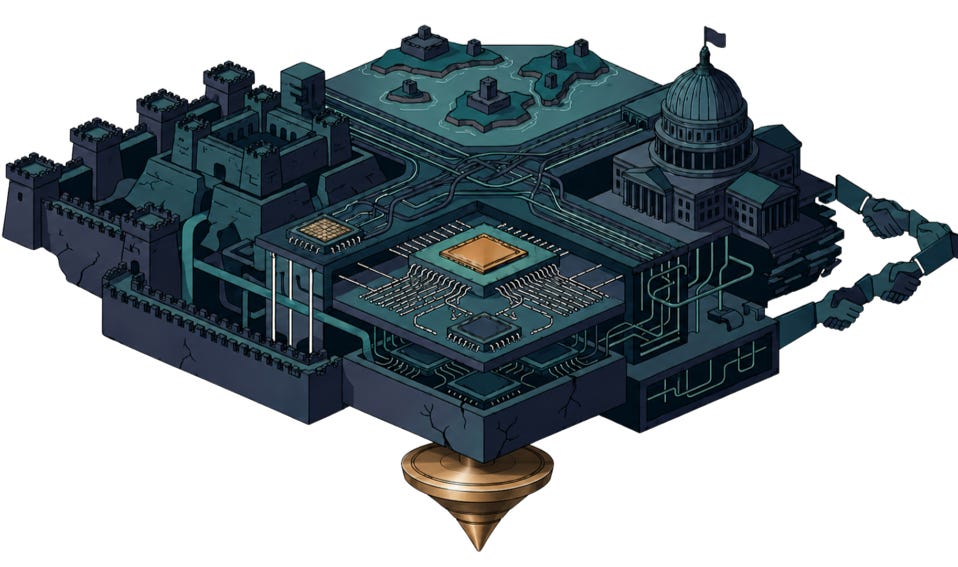
On 17 May 2026, Jonah Goldberg posted a reply on X that sent me down a rabbit hole I have not entirely emerged from. Responding to a clip of Chamath Palihapitiya, the venture capitalist and All-In Podcast co-host, arguing that Taiwan would cease to be strategically important within eighteen months once semiconductor manufacturing moved to American soil, Goldberg wrote: “This is a great example of widget guy thinking once the widget problem is fixed, everything will be fixed. Never mind the democracy erasure, let’s send him to Tokyo, Seoul, Manila, and Sydney to tell our allies that betraying Taiwan will be fine once we can make our own chips.” The post received 164,000 views. Goldberg had named something worth naming, and this piece is an attempt to take that naming seriously.
Palihapitiya’s argument, stripped to its structure, runs as follows. Taiwan’s strategic importance to the United States rests primarily on its semiconductor dominance: TSMC produces the chips on which Nvidia, Apple, and the American defence industrial base depend. As that dependency reduces through domestic manufacturing, the strategic rationale for defending Taiwan weakens proportionately. Eighteen months from now, the argument goes, chips will be made elsewhere, the problem will dissolve, and Taiwan will be just another island. David French of the New York Times called it strategically and morally impoverished thinking. The Australian Strategic Policy Institute noted that Taiwan’s importance extends to its position in the first island chain, to what a Chinese seizure would mean for the regional order, to the precedent it would set for every democratic government currently weighing how much Washington’s commitments are worth. Malcolm Davis of ASPI put the moral dimension plainly: sacrificing a liberal democracy of 24 million people who have struggled hard for their freedoms would resemble the appeasement of Nazi Germany in 1938. None of this appeared to have complicated the original argument.
Palihapitiya is a successful investor with genuine analytical instincts. He is also a Widget Person. And the Widget People, however intelligent, are uniquely dangerous precisely because they are not wrong about the widget. They are wrong about everything the widget is leaning against.
What a Widget Person Believes
The Widget Person is not defined by bad faith, though bad faith is sometimes present. They are defined by a particular kind of single-factor reasoning applied to problems that are fundamentally multi-factor. They identify a real constraint, find a technological or structural solution to that constraint, and conclude that removing the constraint resolves the problem. The widget, in their model, is load-bearing. Remove it and the structure falls. Replace it and the structure holds. What the Widget Person consistently underestimates is how many other structures are leaning against the same wall.
Psychologists understand why this generalisation occurs. The “halo effect” describes the tendency for success in one domain to bleed across into how we judge a person’s abilities in every other domain. Put simply, excellence in one domain, carried across all others. The Widget Person benefits twice from this. First, audiences take a genuine track record in technology or finance and generalise it into an assumed mastery of geopolitics and war strategy. The Second, is called “earned dogmatism”: when people see themselves, and are seen by others, as experts, they feel entitled to be more rigid and dogmatic in their views.
Crucially, this is not about actual competence; it is about felt expertise. This dogmatic behaviour is considered by audiences as substantially more appropriate for perceived experts compared to novices. The more successful the Widget Person has been, the more license they feel, and are granted, to highlight their widget, and dismiss all others.
The pattern recurs with remarkable regularity. The internet was going to make authoritarian governments impossible by giving citizens access to information that regimes could not control. The Arab Spring seemed to validate this thesis. The subsequent decade of digital surveillance states, algorithmic manipulation, and information warfare demolished it. The widget was real. The conclusion drawn from it was not. Economic interdependence was going to make major power conflict obsolete. The deeper China and Russia were integrated into global trade, the more costly conflict would become for all parties, and therefore the less likely. Russia’s invasion of Ukraine and the subsequent economic decoupling demonstrated that political will and nationalist grievance can override the logic of mutual commercial interest. The widget was real. The conclusion drawn from it was not.
Nuclear weapons were going to make conventional war obsolete. This was stated with great confidence in the late 1940s and early 1950s. It preceded Korea, Vietnam, the Falklands, two Gulf Wars, the invasion of Ukraine, and the Iran war of 2026. The nuclear shadow changes the calculus of escalation at the highest levels. It does not prevent conventional conflict below that threshold. The widget was real. The conclusion drawn from it was not.
The Taiwan Case: What the Widget Misses
The semiconductor argument for Taiwan’s strategic importance is genuine and significant. TSMC produces over 90% of the world’s most advanced chips. A disruption to its operations would cripple Nvidia, Apple, and effectively every major technology company on earth. The silicon shield theory, that this dependency deters attack, has real strategic logic. And if that dependency were substantially reduced through domestic manufacturing in the United States and allied countries, the calculus would shift.
But the calculus would shift in one dimension of a problem that has at least six. Taiwan sits at the centre of the first island chain, the geographic barrier that determines whether the Chinese navy can project power freely into the Pacific or remains constrained within it. A Chinese seizure of Taiwan breaks that chain. It changes the strategic geography of the entire Indo-Pacific in ways that have nothing to do with semiconductors. It would validate the proposition that territorial aggression against democracies succeeds when the aggressor is powerful enough, a lesson that would be absorbed by every authoritarian government watching. It would test whether American security guarantees to Japan, South Korea, the Philippines, and Australia mean anything under pressure. It would determine whether the rules-based international order is a real constraint on state behaviour or a set of norms that exist only when convenient.
The mind does not weight those stakes evenly, it reaches for the vivid, personal image and forgets the rest. When researchers asked how much people would pay to save 2,000, 20,000, or 200,000 migrating birds from drowning in oil ponds, the answers were essentially identical in all three cases. The picture in the head of an oil-soaked bird did the work; the magnitude didn’t matter. The semiconductor story has that kind of vivid imprint, we’ve felt supply shocks, understand price rises and cherish Nvidia stock. The first island chain and the signal sent to would-be expansionists is less tangible, the logic more complex, and the impact is unclear. The widget argument lands harder not because it is truer, but because it is easier to picture.
None of these dynamics are altered by where chips are manufactured. The widget is real. The conclusion drawn from it requires the assumption that the chip dependency is the only reason Taiwan matters, which requires ignoring most of what the last seventy years of Indo-Pacific strategy has been about. The Widget Person is not wrong about the chip. They are wrong about the problem.
Drones: The Latest Widget
The same reasoning has migrated to the battlefield, and it is worth examining carefully because the drone case is considerably more sophisticated than the Taiwan chip case, which makes the Widget Person’s error harder to see and therefore more dangerous.

Continue reading this post for free, courtesy of Challenging Geopolitics.
 | A guest post by |