

Trump’s chaos doctrine has cracked OPEC, pushed middle powers into new alignments, and handed Europe an opening it did not design. Can unified diversification reverse a decade of European economic and geopolitical malaise?
On 1 May 2026, two things happened simultaneously that the world’s press mostly covered as separate stories. The United Arab Emirates formally departed OPEC, ending 59 years of membership in the cartel that shaped the modern energy economy. And the EU-Mercosur trade agreement entered provisional validity, creating one of the largest free trade areas on earth after 26 years of negotiation. Two events pointing in the same direction: away from the old order, toward a new era.
Both were made possible by the same force. Trump’s chaos doctrine, through tariffs, an unplanned war, and the systematic erosion of American reliability, broke the political logjams that had held both decisions in place for years. It pushed South American governments toward Brussels when Washington turned hostile. It gave the UAE the cover to leave a cartel it could no longer justify coordinating with. It made the cost of European delay more visible than the cost of European action. Neither the UAE nor the EU designed these conditions. Both moved decisively when the conditions arrived.
The EU had spent a quarter century negotiating with South America while commentators wrote editorials about European irrelevance. The UAE had spent years being told its production ambitions had to be sacrificed for collective discipline while investing billions in capacity that sat idle. Both absorbed sustained pressure without abandoning their long-term direction. On 1 May 2026, that patience was vindicated simultaneously.
This piece argues that these events are twin signals of a deeper reorganisation of the world economy that Trump’s foreign policy has inadvertently catalysed. The global order is, for the first time in a decade, creating conditions in which Europe could genuinely reorganise itself. That opportunity rests on the continued pursuit of unified diversification and a willingness to make the same hard choices the UAE made.
The opportunity is genuine. So are the risks. And the biggest obstacle may be sitting inside Europe’s own borders, in the factory towns of Bavaria and Wolfsburg, where protectionist practices risk defanging any real European resurgence.
‘We Broke It, You Own It’
The Iran war began on 28 February 2026 with US and Israeli airstrikes. Iran responded by closing the Strait of Hormuz, triggering what the IEA described as the largest supply disruption in the history of the global oil market. Brent crude reached $108 a barrel. European gas prices nearly doubled in a week. The ECB postponed rate cuts, raised its inflation forecast, and warned that Germany and Italy faced recession risk. The EU has paid EUR 25 billion more for energy imports since the war began. Chemical and steel manufacturers imposed surcharges of up to 30%. A country with a GDP of only around $400 billion closed the world’s most important energy chokepoint and survived two months of the most advanced air assault in history.
Trump did not consult European governments before launching the strikes. He did not share the intelligence, the planning, or the endgame. He then demanded that Europe clean up the consequences. When they declined, he called them cowards on social media, threatened to withdraw US troops from Spain and Italy, and raised the prospect of NATO withdrawal. Richard Haass of the Council on Foreign Relations captured the doctrine precisely: in an inversion of the old Pottery Barn rule, Trump was telling his European allies ‘We broke it, but you own it.’ Ian Bremmer put the European fury more plainly: after shouldering the entire financial and military burden of Russia’s war in Ukraine, Europe was being called cowards for declining to join a second war it had no hand in starting.
The Iran war has shown what happens when American military power and OPEC production coordination fail simultaneously. Europe had outsourced both. It can no longer afford to.
The UAE’s Exit: A Country Choosing Its Own Future
I want to bring attention to the Iran war, not for the US or Iran, but for the actions taken by the UAE.
The UAE had invested billions expanding its oil production capacity to 4.8 million barrels per day, targeting 5 million by 2027. Under its OPEC quota, it was permitted to produce only 3.2 million. Saxo Bank described the UAE as being in a production quota straitjacket for years. An Emirati official told the Atlantic Council the decision had been a long time coming, discussed behind closed doors for several years.
Trump’s chaos dividend delivered the political moment. Iran, a fellow OPEC member, had been targeting UAE civilian infrastructure with missiles and drones on a scale exceeding the attacks on Israel. Russia, an OPEC+ partner, had been a steadfast supporter of Tehran throughout. The UAE found itself coordinating production policy alongside governments actively attacking it. Their conclusion to leave OPEC should surprise no one. The war that handed Russia a financial windfall and pushed Europe toward stagflation also handed the UAE the political cover to do what its leadership had been planning for years. The chaos produced the opening. Abu Dhabi walked through it.
The departure is lockstep with their long-term strategy for prosperity. The UAE desires to accelerate its transformation into a post-oil technology and finance hub, aligned with democratic markets and built for a world in which fossil fuel revenues are a declining strategic asset. Abu Dhabi has committed $148 billion to AI since 2024, is hosting Microsoft and OpenAI’s hyperscaler infrastructure, and has committed $1.4 trillion into US AI and infrastructure. Dubai, in which 89% of the population are foreign nationals, is the physical expression of that bet: a jurisdiction that functions, tolerates ambiguity, and rewards competence. The UAE has placed that bet with more conviction than most Western governments have managed themselves.
The risks are real. The UAE absorbed more missile and drone strikes than Israel during the Iran war while operating under informal rather than treaty-bound security arrangements. None of this negates the strategic clarity of the decision. The UAE assessed which of its structures were protecting the future and which were protecting the past, and exited the latter. That is precisely the logic this piece argues Europe must now apply to itself.
For Europe, the oil price consequences of the UAE’s decision are a coming dividend. By leaving OPEC, Abu Dhabi is free to produce at full capacity, approximately 1.6 million barrels per day above its former quota. Saudi Arabia must either cut its own output to compensate or allow prices to fall, and its history suggests it will not accept the revenue sacrifice indefinitely. OPEC’s share of global production has already fallen from roughly 50% at its founding to approximately 33% today. For a continent that has just absorbed EUR 25 billion in additional energy costs from a single conflict, a structurally lower oil price over the coming decade would be an enormous dividend from a decision made in Abu Dhabi. The chaos that cost Europe so dearly is, in this one dimension at least, paying it back.
Yet, lower oil prices alone do not build strategic independence. For that, Europe needed something it had been negotiating for 26 years.
Unified Diversification: Mercosur, 26 years better late than never
The EU-Mercosur agreement entering provisional validity on the same day as the UAE’s OPEC departure is the less-covered event and the more structurally significant for Europe’s long-term position. The deal had been in negotiation since 1999. Twenty-six years of summits, stalled drafts, environmental objections from France, and agricultural lobbying from European farmers produced a running commentary about European institutional paralysis. France alone had blocked completion on multiple occasions, citing threats to its agricultural sector. Germany’s car industry, whose interests in Brazilian market access were directly served by the deal, simultaneously lobbied against the emissions standards that would have made European EVs competitive enough to justify the access. The opposition was real, organised, and had succeeded in delaying completion for a generation.
Then Trump’s chaos doctrine changed the political arithmetic. His tariff regime landed in 2025, pushing South American governments to look elsewhere for reliable trading partners. His Iran war drove energy costs across Europe to levels that made the cost of continued delay feel more dangerous than the cost of completion. His broader posture of American unreliability made the argument for European strategic autonomy, and for the trade architecture that underwrites it, suddenly persuasive to governments that had previously been comfortable free-riding on American-led order. The political will in Brussels to absorb the domestic pain of completion became stronger than the will to keep delaying. The Atlantic Council noted plainly that opponents of the deal can blame Trump for its conclusion. That is accurate. It is also incomplete. The deal required two and a half decades of negotiating groundwork that survived changes of government, financial crises, and a global pandemic. Patience is its own form of strategy. But it was the chaos that finally broke the logjam.
The agreement creates a free trade zone across 31 countries and approximately 730 million people. For European exporters, tariff savings could reach EUR 4 billion annually. Cars currently facing 35% tariffs in Brazil gain access at progressively lower rates. The more strategically significant element, however, is what South America contains that Europe needs: nickel, copper, lithium, aluminium, and titanium, the critical raw materials at the centre of both the green energy transition and the autonomous systems supply chain. China has been the dominant external investor in South American mineral extraction for years, keeping value-add in Chinese facilities and away from partner economies. Mercosur may help shift the balance away from further Chinese dominance.
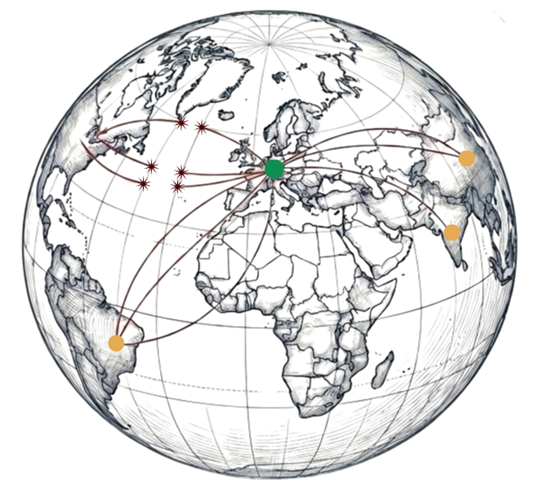
The Mercosur deal, combined with the EU-Indonesia agreement concluded in 2025 and the EU-India deal signed in January 2026, gives Europe preferential access to the supply chains and consumer markets of emerging economies across two billion people who are neither China nor the United States. No single European government could have negotiated any of these agreements alone. Each required the EU to act as a single strategic entity, absorbing internal political friction and external pressure simultaneously.
Many commentators in Europe wanted a trade war with Washington and were angry at the unfavourable terms. Yet, it seems Europe played their cards well, focussing instead on unified diversification that could pay off over the next decade.
Germany’s Protection Racket
There is a structural blockade at the centre of these opportunities that shows no signs of being addressed. The UAE escaped a cartel that protected legacy producers at the cost of future positioning. Mercosur succeeds partly because it opens markets for European cars. Yet Germany, Europe’s largest economy and the single biggest beneficiary of those car market openings, is simultaneously using its political weight inside European institutions to protect its combustion engine industry in exactly the way that OPEC members have protected their oil revenues: by deploying collective political leverage to slow the structural transition that would otherwise force adaptation. Indeed, the largest winner of Mercosur is predicted to be Germany, with a new outlet for its ICE cars, while they transition to EVs at home.
The German automotive sector accounts for nearly 5% of Germany’s GDP and directly employs over 800,000 people, yet its political influence is even greater than these figures suggest. When the EU proposed a 2035 ban on new combustion engine vehicle sales, Germany led the opposition, securing an exemption for synthetic e-fuels that has no plausible pathway to commercial scale. When Brussels proposed tighter CO2 targets, the industry response, amplified by ACEA, BMW, VW, and Mercedes-Benz, argued that European consumers were simply not ready for electric vehicles. The Jacques Delors Centre described this demand-deficit narrative as a convenient conclusion that downplays the structural dynamics of a market shifting decisively toward electrification, one that draws convenient policy conclusions in the process.
The data does not support Germany car cartel narratives. BYD surpassed Tesla in European EV sales in April 2025. The BYD Dolphin Surf starts at EUR 22,990, significantly undercutting German offerings at a comparable spec. Volkswagen Group’s China market share has fallen from 19% in 2019 to 14.5% in 2024, overtaken in its largest market by BYD. German brands collectively hold 1.6% combined EV market share in China. VW is cutting up to 30,000 jobs from its 300,000-strong workforce. The iconic Wolfsburg plant, once producing 870,000 cars annually, made fewer than 500,000 in 2023. Germany’s new car registrations fell 28% in August 2024.
Yes, Chinese dominance of EV supply chains, magnet production, and battery technology was built on state subsidy at a scale Europe cannot match. That is a legitimate grievance. But blocking Chinese cars from Europe does not reverse this EV revolution. Like every technological breakthrough before it, the EV transition will not be stopped by tariffs. Protectionism delays the inevitable while leaving sheltered industries further behind than if the political will and capital had been directed at competing rather than resisting.
The German automotive industry is not a successful model under temporary pressure. It is a declining model using its political proximity to Berlin and Brussels to slow the policy environment that would accelerate the transition. The UAE did not wait for oil revenues to fall before building its alternative. Germany is waiting. And every year it signals protecting declining sectors, the world will continue to see Europe as a museum, not a leader.
Collecting the Dividend
Europe did not design any of this. It did not ask for a war in Iran, an energy shock, or an American president who treats his closest allies as leverage instruments. It did not orchestrate the UAE’s exit from OPEC or engineer the conditions that finally pushed South American governments to close a deal that had been stalling since 1999. The chaos arrived and as usual, Europe are reacting to events rather than shaping them. Yet, the opportunities it created are real, nonetheless.
The UAE’s departure from OPEC will, when the Strait of Hormuz reopens, put structurally lower oil prices within reach for a continent that has just paid EUR 25 billion more for energy from a single conflict. Mercosur, combined with the EU-Indonesia and EU-India agreements, gives Europe preferential access to the raw materials and consumer markets of emerging economies across two billion people who are neither Chinese nor American. Neither prize is guaranteed. Both require Europe to act as the single strategic entity that unified diversification demands, rather than reverting to the fragmented national lobbying that has historically diluted every Brussels-level ambition.
The harder test is domestic. The UAE made a decisive break from a structure that was protecting its past at the cost of its future. Europe is being asked to make the same kind of break with its own automotive legacy, and the political economy of that choice is considerably more difficult. Combustion engine protection is not Saudi Arabia’s problem. It is Germany’s, and it sits inside the same European institutions that signed the Mercosur deal. Whether Berlin will absorb the transition costs of electrification with the same strategic patience it brought to trade negotiations is the question that determines whether the chaos dividend gets collected or squandered.
The world is not becoming more predictable. It is, for the first time in a decade, moving in ways that reward patience, strategic nerve, and the willingness to break from structures that suited a unipolar order. Whether the governments that set European industrial policy will follow is the question that determines whether the chaos dividend gets collected.
References
Al Jazeera. (2026) ‘India, EU Agree on Mother of All Trade Deals.’ Al Jazeera, 27 January 2026.
Al Jazeera. (2026) ‘UAE Quits OPEC: What That Means for the Gulf, Energy Markets and Beyond.’ Al Jazeera, 29 April 2026.
Atlantic Council. (2026) ‘The EU and Mercosur Are Creating One of the World’s Largest Free Trade Areas.’ Atlantic Council, 9 January 2026.
Atlantic Council. (2026) ‘Why Is the UAE Leaving OPEC?’ Atlantic Council FastThinking, 29 April 2026.
Bruegel. (2026) ‘How Will the Iran Conflict Hit European Energy Markets?’ Bruegel, 2 March 2026.
Carscoops. (2026) ‘China EV Sales Collapsed by Nearly 20%, and Germany’s Big Five Are Down to 1.6%.’ Carscoops, April 2026.
CNN. (2026) ‘Europe Didn’t Want an Iran War, Yet Trump Is Saddling It With the Consequences.’ CNN, 2 April 2026.
CNBC. (2026) ‘United Arab Emirates to Leave OPEC May 1.’ CNBC, 28 April 2026.
CNBC. (2026) ‘US Being Humiliated by Iran, Says Germany’s Merz, as Europe’s Patience Wanes.’ CNBC, 28 April 2026.
CSIS. (2026) ‘Who Is Winning the Iran War?’ Center for Strategic and International Studies, 25 March 2026.
European Policy Centre. (2026) ‘Unleashing the Potential of EU-India Cooperation Beyond the Free Trade Agreement.’ EPC, 3 March 2026.
Gulf News. (2026) ‘UAE to Exit OPEC in 2026: Officials and Experts Explain Reasons.’ Gulf News, 29 April 2026.
IPS Journal. (2026) ‘Rivalry Within Limits: Foreign and Security Policy in the Gulf.’ IPS Journal, April 2026.
Jacques Delors Centre. (2025) ‘Europe’s Car Industry in Transition: Stuck in Neutral?’ Jacques Delors Centre, 2025.
JINSA. (2026) ‘The Emirati Moment: The UAE’s Strategic Cycle and the Iran War.’ JINSA, April 2026.
Kyiv School of Economics Institute. (2026) ‘Iran War Helps Russia; Long Conflict Would Fundamentally Undermine Economic Pressure Campaign.’ KSE Institute, 20 March 2026.
Motor Finance Online. (2025) ‘2026 and Beyond: Reinventing Europe’s Automotive Promise.’ December 2025.
Newsweek. (2026) ‘NATO Ally Says US Humiliated on Iran but Blockade Is Forcing Negotiations.’ Newsweek, 28 April 2026.
RAND Corporation. (2026) ‘Trump’s Iran War Is a Dilemma, Not a Debacle.’ RAND Commentary, 1 April 2026.
Sullivan and Cromwell. (2026) ‘EU Strikes Major Trade Deals with Mercosur and India.’ Sullivan and Cromwell, 9 February 2026.
The National. (2025) ‘AI Investment a Game Changer for UAE and Gulf, Jihad Azour Says.’ The National, 8 December 2025.
Washington Monthly. (2026) ‘The US-Europe Rift: How Trump’s Iran War Is Making It Worse.’ Washington Monthly, 17 April 2026.
Wikipedia. (2026) ‘2026 Iran War.’ Available at: en.wikipedia.org.
Wikipedia. (2026) ‘Economic Impact of the 2026 Iran War.’ Available at: en.wikipedia.org.
Wikipedia. (2026) ‘EU-Mercosur Partnership Agreement.’ Available at: en.wikipedia.org.
Wikipedia. (2026) ‘Volkswagen Group China.’ Available at: en.wikipedia.org.
The EU is ready to support Armenia in becoming a regional hub for global trade routes, Commission President von der Leyen said at the signing ceremony in the capital, Yerevan. The bloc will primarily support the development of digital technologies and renewable energies. She also pledged support to Armenia in protecting the parliamentary elections in June and in defending against cyberattacks and disinformation campaigns.
Armenia aims to become less dependent on its traditional ally, Russia. Last year, parliament called on the government to begin the EU accession process.