
The Second Pillar
What Witnesses Cannot Provide


Imagine you are watching someone get mugged at gunpoint. Afterwards, a detective asks you how much money was stolen. You can probably describe the gun in some detail – the shape of the barrel, the colour, how it was held. The money changing hands is much harder to bring into focus. This is not your eyes failing you, it is your brain doing exactly what it evolved to do.
Our attention under threat is selective, and that selectivity is not random. It follows a logic, putting survival first and context last. What any witness can tell you is not simply a function of how close they were, how traumatic the experience was, or how carefully they try to remember. It is determined by how our brains work when the body believes it is in danger.
This piece is about what that means for documenting atrocity, and why a Russian state procurement database turns out to be part of the answer.
Researchers call what happened to your attention in that mugging scenario the weapon focus effect. Eye-tracking studies show witnesses fixating on the weapon while their recall of almost everything surrounding it degrades (Loftus, Loftus, and Messo 1987; Fawcett et al. 2013). The weapon focus effect is one instance of a broader pattern that researchers call tunnel memory: under significant threat, attention tightens around whatever the brain has tagged as most relevant to survival, and the rest is remembered weakly or not at all (Safer et al. 1998). What gets captured vividly is the act, the sensation, the face, the gun. What gets lost is the surroundings, the counts, the sequences, the durations. This is the mind working exactly as it should – but what does that actually look like?
Under normal conditions, three brain systems share the work of turning an experience into a memory. One flags what is emotionally significant and potentially dangerous (you may have heard of the Amygdala). A second weaves the event into a coherent episode: where it happened, in what order, how long it lasted, what surrounded it. A third provides the slower, reflective voice that lets you narrate an account; this is what lets you say it was Tuesday, there were three of them, it lasted about forty seconds. Under threat, this arrangement shifts. Stress hormones push the reflective, narrating system to the background and amplify the danger-tagging system (Schwabe et al. 2012). The result is uncomfortable but logical. The emotional and sensory aspects of the experience get burned in, while the contextual information is remembered weakly or not at all. The brain is running an algorithm, survival always comes first, and record-keeping is forgotten.
That same pattern holds at far greater extremes. Survivors of detention, torture, and systematic abuse consistently produce testimony that is extraordinarily rich on experience but thin on the peripheral information. Courts have had to deal with this for decades. International tribunals have repeatedly encountered mismatches in counts and timings and declined to treat them as automatic signs of dishonesty; the guidance that has settled out of those cases treats such gaps as expected features of traumatised testimony, not marks against credibility (Chlevickaitė, Holá, and Bijleveld 2020). That is the right call. But recognising the limitation is not the same as overcoming it. When the peripheral information is exactly what a court requires, something else is needed.
The Limits of Witnessing
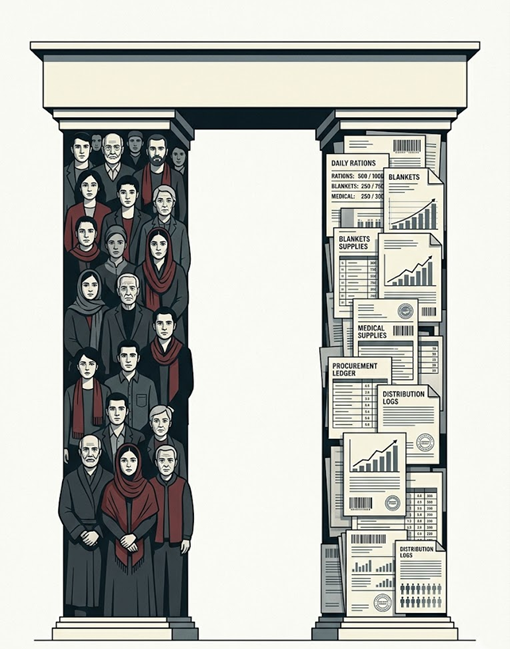
There are two fundamentally different categories of fact in any atrocity case. The first is experiential: what happened to people, what they witnessed, what was done to them. The second is institutional: what the state authorised, paid for, contracted, and built. These categories differ entirely. The facts that reveal whether a detention system was organised, sustained, and deliberately scaled were never available to human perception in the first place. No greater amount of witnesses, or better interviewing, or more careful testimony collection will fill this gap. The machinery that makes atrocity possible operates remotely from the people it is used against. Human testimony tells you what the machine did. It cannot tell you how the machine was built, who authorised it, or at what cost.
Procurement records operate in the category that human testimony cannot reach. They know nothing about beatings or electric shocks and has nothing to say about what any individual experienced. What they capture is the institutional backdrop. A discrepancy between what a facility officially holds and what the state is paying to feed is not testimony. It does not describe suffering. But it documents, in their own administrative language, that the state was paying to hold people it was not acknowledging. This is a different category of evidence entirely, answering questions that human perception was never going to answer.
The State’s Own Records
The methods and the case study of IK‑10 in this piece come directly from the Procurment OSINT guide, developed by Manon-Catherine Balbinot (2026).
IK-10 is a penal colony in Russia’s Mordovia region, a facility usually reserved for men serving life sentences. Since the full-scale invasion of Ukraine, Ukrainian prisoners of war and civilians taken from occupied territories have been transferred there in significant numbers. It is also the case study at the centre of the accompanying OSINT guide, and it shows, in concrete terms, what happens when you bring both categories of evidence to bear on the same facility.
In 2025, the BBC’s Russian Service published an investigation based on interviews with six former prisoners. They described a consistent pattern of beatings, dog attacks, and chronic malnutrition. One former prisoner had lost twenty kilograms over eleven months (BBC News Russian 2025). Those accounts detail the extraordinary suffering they had to bear, the kind of detail that no administrative record will ever contain. But they were not able to describe how many people IK-10 was holding, or how that number compared with official capacity.
Russian penitentiary facilities publish their supply contracts through public procurement systems. Those contracts specify what is being bought, in what quantities, for which periods, and by which institution. The guide takes IK-10 as a case study and uses procurement quantities as a population proxy over time. The approach starts by building a pre-war baseline of food quantities ordered for the facility, then converts those quantities into implied population figures using daily ration assumptions. If that baseline aligns with the facility’s known capacity, the method is validated and the same logic can be applied to wartime data. Where the numbers diverge, the difference becomes the finding. As an additional check, the same pattern is tracked across other procurement categories that scale with population, things like bedding, clothing, hygiene supplies and medical consumables. A single anomalous food order could have an innocent explanation. A consistent divergence across every supply line is harder to dismiss.
In the IK-10 data, the pre-war estimates align closely with the facility’s stated capacity. Wartime procurement shows supplies consistent with a significantly larger population. The precise figures are in the guide. What matters here is that two entirely independent sources – one human, one administrative, arrive at the same picture.
Human experience of violence is always partial. That is how the brain works when the body is under threat. Attention narrows, survival takes precedence, and the surroundings fall away. What remains is vivid, painful, and irreplaceable. It is also incomplete in specific and important ways.
Procurement data accesses a category of information human experience was not designed capture. The state’s own record of what it built, what it paid for, and what it sustained. Together, the two sources produce something neither can produce alone: a documented picture of what happened, and what the state constructed to make it happen.
References
BBC News Russian. 2025. “‘A Place Where They Kill Slowly’: The BBC Investigates the Treatment of Ukrainian Prisoners in a Notorious Russian Jail.” The Best of BBC News Russian - in English. September 24, 2025. https://bbcrussian.substack.com/p/a-place-where-they-kill-slowly.
Chlevickaitė, G., B. Holá, and C. Bijleveld. 2020. “Judicial Witness Assessments at the ICTY, ICTR and ICC: Is There ‘Standard Practice’in International Criminal Justice?” Journal of International Criminal Justice 18 (1): 185–210. https://doi.org/10.1093/jicj/mqaa002/33394479/mqaa002.
Fawcett, Jonathan M., Emily J. Russell, Kristine A. Peace, and John Christie. 2013. “Of Guns and Geese: A Meta-Analytic Review of the ‘Weapon Focus’ Literature.” Psychology, Crime & Law: PC & L 19 (1): 35–66. https://doi.org/10.1080/1068316x.2011.599325.
Loftus, Elizabeth F., Geoffrey R. Loftus, and Jane Messo. 1987. “Some Facts about ‘Weapon Focus.’” Law and Human Behavior 11 (1): 55–62. https://doi.org/10.1007/bf01044839.
Safer, Martin A., Sven-Åke Christianson, Marguerite W. Autry, and Karin Österlund. 1998. “Tunnel Memory for Traumatic Events.” Applied Cognitive Psychology 12 (2): 99–117. https://doi.org/10.1002/(sici)1099-0720(199804)12:2<99::aid-acp509>3.0.co;2-7.
Schwabe, Lars, Marian Joëls, Benno Roozendaal, Oliver T. Wolf, and Melly S. Oitzl. 2012. “Stress Effects on Memory: An Update and Integration” 36 (7): 1740–49. https://www.sciencedirect.com/science/article/pii/S0149763411001370.
 | A guest post by |